
 Tweet
Tweet
NSA monitored calls of 35 world leaders after US official handed over contacts
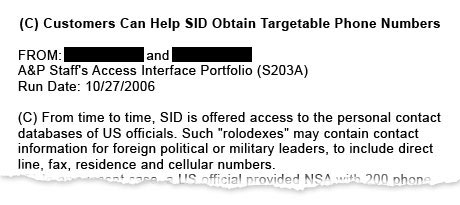
The NSA memo suggests that such surveillance was not isolated as the agency routinely monitors world leaders.
The National Security Agency monitored the phone conversations of 35 world
leaders after being given the numbers by an official in another US
government department, according to a classified document provided by
whistleblower Edward Snowden.
The confidential memo reveals that the NSA encourages senior officials in its
"customer" departments, such the White House, State and the Pentagon, to
share their "Rolodexes" so the agency can add the phone numbers of leading
foreign politicians to their surveillance systems.
The document notes that one unnamed US official handed over 200 numbers,
including those of the 35 world leaders, none of whom is named. These were
immediately "tasked" for monitoring by the NSA.
The revelation is set to add to mounting diplomatic tensions between the US
and its allies, after the German chancellor Angela Merkel on Wednesday
accused the US of tapping her mobile phone.
After Merkel's allegations became public, White House press secretary Jay
Carney issued a statement that said the US "is not monitoring and will not
monitor" the German chancellor's communications. But that failed to quell the
row, as officials in Berlin quickly pointed out that the US did not deny
monitoring the phone in the past.
The NSA memo obtained by the Guardian suggests that such surveillance was
not isolated, as the agency routinely monitors the phone numbers of world
leaders – and even asks for the assistance of other US officials to do so.
The memo, dated October 2006 and which was issued to staff in the agency's
Signals Intelligence Directorate (SID), was titled "Customers Can Help SID
Obtain Targetable Phone Numbers".
It begins by setting out an example of how US officials who mixed with world
leaders and politicians could help agency surveillance.
"In one recent case," the memo notes, "a US official provided NSA with 200
phone numbers to 35 world leaders … Despite the fact that the majority is
probably available via open source, the PCs [intelligence production centers]
have noted 43 previously unknown phone numbers. These numbers plus
several others have been tasked."
The document continues by saying the new phone numbers had helped the
agency discover still more new contact details to add to their monitoring:
"These numbers have provided lead information to other numbers that have
subsequently been tasked."
But the memo acknowledges that eavesdropping on the numbers had
produced "little reportable intelligence". In the wake of the Merkel row, the US
is facing growing international criticism that any intelligence benefit from
spying on friendly governments is far outweighed by the potential diplomatic
damage.
The memo then asks analysts to think about any customers they currently
serve who might similarly be happy to turn over details of their contacts.
"This success leads S2 [signals intelligence] to wonder if there are NSA
7liaisons whose supported customers may be willing to share their 'Rolodexes'
or phone lists with NSA as potential sources of intelligence," it states. "S2
welcomes such information!"
The document suggests that sometimes these offers come unsolicited, with
US "customers" spontaneously offering the agency access to their overseas
networks.
"From time to time, SID is offered access to the personal contact databases
of US officials," it states. "Such 'Rolodexes' may contain contact information
for foreign political or military leaders, to include direct line, fax, residence and cellular numbers."
The Guardian approached the Obama administration for comment on the latest
document. Officials declined to respond directly to the new material, instead
referring to comments delivered by Carney at Thursday's daily briefing.
Carney told reporters: "The [NSA] revelations have clearly caused tension in
our relationships with some countries, and we are dealing with that through
diplomatic channels.
"These are very important relations both economically and for our security,
and we will work to maintain the closest possible ties."
The public accusation of spying on Merkel adds to mounting political tensions
in Europe about the scope of US surveillance on the governments of its allies,
after a cascade of backlashes and apologetic phone calls with leaders across
the continent over the course of the week.
Asked on Wednesday evening if the NSA had in the past tracked the German
chancellor's communications, Caitlin Hayden, the White House's National
Security Council spokeswoman, said: "The United States is not monitoring and
will not monitor the communications of Chancellor Merkel. Beyond that, I'm not
in a position to comment publicly on every specific alleged intelligence
activity."
At the daily briefing on Thursday, Carney again refused to answer repeated
questions about whether the US had spied on Merkel's calls in the past.
The NSA memo seen by the Guardian was written halfway through George W
Bush's second term, when Condoleezza Rice was secretary of state and
Donald Rumsfeld was in his final months as defence secretary.
Merkel, who, according to Reuters, suspected the surveillance after finding
her mobile phone number written on a US document, is said to have called for
US surveillance to be placed on a new legal footing during a phone call to President Obama.
"The [German] federal government, as a close ally and partner of the US,
expects in the future a clear contractual basis for the activity of the services
and their co-operation," she told the president.
The leader of Germany's Green party, Katrin Goring-Eckhart, called the alleged
spying an "unprecedented breach of trust" between the two countries.
Earlier in the week, Obama called the French president François Hollande in
response to reports in Le Monde that the NSA accessed more than 70m phone
records of French citizens in a single 30-day period, while earlier reports in Der
Spiegel uncovered NSA activity against the offices and communications of
senior officials of the European Union.
The European Commission, the executive body of the EU, this week backed
proposals that could require US tech companies to seek permission before
handing over EU citizens' data to US intelligence agencies, while the European
parliament voted in favour of suspending a transatlantic bank data sharing
agreement after Der Spiegel revealed the agency was monitoring the
international bank transfer system Swift.
Bron: www.theguardian.com, 24/10/2013
Mening: Om eerst even het artikel samen te vatten: nadat er eerst
bekend was geworden dat de Duitse Bondskanselier Merkel werd afgeluisterd
door de NSA is er nu ook bekend geraakt dat het in totaal over 35 toppolitici
gaat.
Wat ik eigenlijk het strafste aan dit alles vind, is hoe een land hierin kan
slagen zonder vroeger door de mand te vallen. Als Snowden er niet was
geweest, wisten wij waarschijnlijk nog altijd van niets. Als het zo gemakkelijk
is om zulke belangrijke en beveiligde/beschermde mensen af te luisteren, wie
weet wat men al dan niet weet over de gewone man in de straat. Het geeft
mij een beetje het gevoel alsof we in de roman van George Orwell zitten
(1984) en 'Big Brother' ons altijd bekijkt. Technologie is een mooie uitvinding
maar er wordt zo vaak en zo gemakkelijk misbruik van gemaakt. Wat blijft er
nog over van onze privacy?
The NSA memo suggests that such surveillance was not isolated as the agency routinely monitors world leaders.
The National Security Agency monitored the phone conversations of 35 world
leaders after being given the numbers by an official in another US
government department, according to a classified document provided by
whistleblower Edward Snowden.
The confidential memo reveals that the NSA encourages senior officials in its
"customer" departments, such the White House, State and the Pentagon, to
share their "Rolodexes" so the agency can add the phone numbers of leading
foreign politicians to their surveillance systems.
The document notes that one unnamed US official handed over 200 numbers,
including those of the 35 world leaders, none of whom is named. These were
immediately "tasked" for monitoring by the NSA.
The revelation is set to add to mounting diplomatic tensions between the US
and its allies, after the German chancellor Angela Merkel on Wednesday
accused the US of tapping her mobile phone.
After Merkel's allegations became public, White House press secretary Jay
Carney issued a statement that said the US "is not monitoring and will not
monitor" the German chancellor's communications. But that failed to quell the
row, as officials in Berlin quickly pointed out that the US did not deny
monitoring the phone in the past.
The NSA memo obtained by the Guardian suggests that such surveillance was
not isolated, as the agency routinely monitors the phone numbers of world
leaders – and even asks for the assistance of other US officials to do so.
The memo, dated October 2006 and which was issued to staff in the agency's
Signals Intelligence Directorate (SID), was titled "Customers Can Help SID
Obtain Targetable Phone Numbers".
It begins by setting out an example of how US officials who mixed with world
leaders and politicians could help agency surveillance.
"In one recent case," the memo notes, "a US official provided NSA with 200
phone numbers to 35 world leaders … Despite the fact that the majority is
probably available via open source, the PCs [intelligence production centers]
have noted 43 previously unknown phone numbers. These numbers plus
several others have been tasked."
The document continues by saying the new phone numbers had helped the
agency discover still more new contact details to add to their monitoring:
"These numbers have provided lead information to other numbers that have
subsequently been tasked."
But the memo acknowledges that eavesdropping on the numbers had
produced "little reportable intelligence". In the wake of the Merkel row, the US
is facing growing international criticism that any intelligence benefit from
spying on friendly governments is far outweighed by the potential diplomatic
damage.
The memo then asks analysts to think about any customers they currently
serve who might similarly be happy to turn over details of their contacts.
"This success leads S2 [signals intelligence] to wonder if there are NSA
7liaisons whose supported customers may be willing to share their 'Rolodexes'
or phone lists with NSA as potential sources of intelligence," it states. "S2
welcomes such information!"
The document suggests that sometimes these offers come unsolicited, with
US "customers" spontaneously offering the agency access to their overseas
networks.
"From time to time, SID is offered access to the personal contact databases
of US officials," it states. "Such 'Rolodexes' may contain contact information
for foreign political or military leaders, to include direct line, fax, residence and cellular numbers."
The Guardian approached the Obama administration for comment on the latest
document. Officials declined to respond directly to the new material, instead
referring to comments delivered by Carney at Thursday's daily briefing.
Carney told reporters: "The [NSA] revelations have clearly caused tension in
our relationships with some countries, and we are dealing with that through
diplomatic channels.
"These are very important relations both economically and for our security,
and we will work to maintain the closest possible ties."
The public accusation of spying on Merkel adds to mounting political tensions
in Europe about the scope of US surveillance on the governments of its allies,
after a cascade of backlashes and apologetic phone calls with leaders across
the continent over the course of the week.
Asked on Wednesday evening if the NSA had in the past tracked the German
chancellor's communications, Caitlin Hayden, the White House's National
Security Council spokeswoman, said: "The United States is not monitoring and
will not monitor the communications of Chancellor Merkel. Beyond that, I'm not
in a position to comment publicly on every specific alleged intelligence
activity."
At the daily briefing on Thursday, Carney again refused to answer repeated
questions about whether the US had spied on Merkel's calls in the past.
The NSA memo seen by the Guardian was written halfway through George W
Bush's second term, when Condoleezza Rice was secretary of state and
Donald Rumsfeld was in his final months as defence secretary.
Merkel, who, according to Reuters, suspected the surveillance after finding
her mobile phone number written on a US document, is said to have called for
US surveillance to be placed on a new legal footing during a phone call to President Obama.
"The [German] federal government, as a close ally and partner of the US,
expects in the future a clear contractual basis for the activity of the services
and their co-operation," she told the president.
The leader of Germany's Green party, Katrin Goring-Eckhart, called the alleged
spying an "unprecedented breach of trust" between the two countries.
Earlier in the week, Obama called the French president François Hollande in
response to reports in Le Monde that the NSA accessed more than 70m phone
records of French citizens in a single 30-day period, while earlier reports in Der
Spiegel uncovered NSA activity against the offices and communications of
senior officials of the European Union.
The European Commission, the executive body of the EU, this week backed
proposals that could require US tech companies to seek permission before
handing over EU citizens' data to US intelligence agencies, while the European
parliament voted in favour of suspending a transatlantic bank data sharing
agreement after Der Spiegel revealed the agency was monitoring the
international bank transfer system Swift.
Bron: www.theguardian.com, 24/10/2013
Mening: Om eerst even het artikel samen te vatten: nadat er eerst
bekend was geworden dat de Duitse Bondskanselier Merkel werd afgeluisterd
door de NSA is er nu ook bekend geraakt dat het in totaal over 35 toppolitici
gaat.
Wat ik eigenlijk het strafste aan dit alles vind, is hoe een land hierin kan
slagen zonder vroeger door de mand te vallen. Als Snowden er niet was
geweest, wisten wij waarschijnlijk nog altijd van niets. Als het zo gemakkelijk
is om zulke belangrijke en beveiligde/beschermde mensen af te luisteren, wie
weet wat men al dan niet weet over de gewone man in de straat. Het geeft
mij een beetje het gevoel alsof we in de roman van George Orwell zitten
(1984) en 'Big Brother' ons altijd bekijkt. Technologie is een mooie uitvinding
maar er wordt zo vaak en zo gemakkelijk misbruik van gemaakt. Wat blijft er
nog over van onze privacy?